torch_brain.transforms
Compose several transforms together. |
|
Apply a single transformation randomly picked from a list. |
|
Conditionally apply a single transformation based on whether a condition is met. |
|
Randomly drop units from the data.units and data.spikes. |
|
Randomly scales the time axis. |
|
Randomly drops output samples. |
- class Compose(transforms)[source]
Bases:
objectCompose several transforms together. All transforms will be called sequentially, in order, and must accept and return a single
temporaldata.Dataobject, except the last transform, which can return any object.- Parameters:
transforms (list of callable) – list of transforms to compose.
- class RandomChoice(transforms, p=None)[source]
Bases:
objectApply a single transformation randomly picked from a list.
- class ConditionalChoice(condition, true_transform, false_transform)[source]
Bases:
objectConditionally apply a single transformation based on whether a condition is met.
- class UnitDropout(field='spikes', reset_index=True, *args, **kwargs)[source]
Bases:
objectAugmentation that randomly drops units from the sample. By default, the number of units to keep is sampled from a triangular distribution defined in
TriangleDistribution.This transform assumes that the data has a units object. It works for both
IrregularTimeSeriesandRegularTimeSeries. For the former, it will drop spikes from the units that are not kept. For the latter, it will drop the corresponding columns from the data.- Parameters:
field (str, optional) – Field to apply the dropout. Defaults to “spikes”.
*args – Arguments to pass to the
TriangleDistributionconstructor.**kwargs –
Arguments to pass to the
TriangleDistributionconstructor.
- class TriangleDistribution(min_units=20, mode_units=100, max_units=300, tail_right=None, peak=4, M=10, max_attempts=100, seed=None)[source]
Bases:
objectTriangular distribution with a peak at mode_units, going from min_units to max_units.
The unnormalized density function is defined as:
\[\begin{split}f(x) = \begin{cases} 0 & \text{if } x < \text{min_units} \\ 1 + (\text{peak} - 1) \cdot \frac{x - \text{min_units}}{\text{mode_units} - \text{min_units}} & \text{if } \text{min_units} \leq x \leq \text{mode_units} \\ \text{peak} - (\text{peak} - 1) \cdot \frac{x - \text{mode_units}}{\text{tail_right} - \text{mode_units}} & \text{if } \text{mode_units} \leq x \leq \text{tail_right} \\ 1 & \text{if } \text{tail_right} \leq x \leq \text{max_units}\\ 0 & \text{otherwise} \end{cases}\end{split}\]- Parameters:
min_units (int) – Minimum number of units to sample. If the population has fewer units than this, all units will be kept.
mode_units (int) – Mode of the distribution.
max_units (int) – Maximum number of units to sample.
tail_right (int, optional) – Right tail of the distribution. If None, it is set to max_units.
peak (float, optional) – Height of the peak of the distribution.
M (float, optional) – Normalization constant for the proposal distribution.
max_attempts (int, optional) – Maximum number of attempts to sample from the distribution.
seed (int, optional) – Seed for the random number generator.
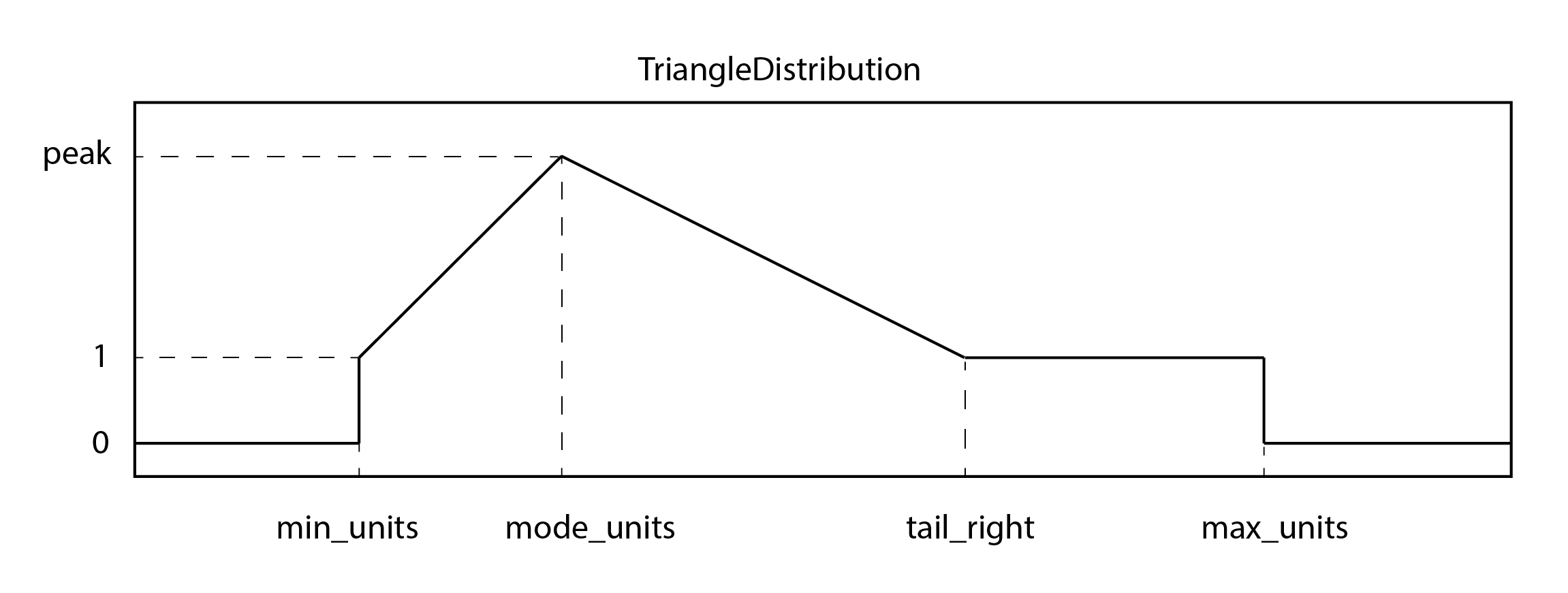
To sample from the distribution, we use rejection sampling. We sample from a uniform distribution between min_units and max_units and accept the sample with probability \(\frac{f(x)}{M \cdot q(x)}\), where \(q(x)\) is the proposal distribution.